Chapter 3
Times Change
“Facts which at first seem improbable will, even on scant explanation, drop the cloak which has hidden them and stand forth in naked and simple beauty.”
Galileo
The ancient Hebrew model of the universe originated about 500 BCE. Aristotle’s model originated about 350 BCE. Both models were ancient by the year 1500 CE. Christianity accepted the view of Aristotle because of the evidence of astronomy, the observations of the heavenly bodies, and because Christianity could continue to believe that the earth was the stationary center of the universe, and God (the Prime Mover in Aristotle’s system) was still up above it. Or surrounding it. God was still there, although more like out there. By the year 1500, we humans had an understanding of outer space, even though telescopes had not yet been invented. Not quite, although that would come quite soon. In 1500, Christianity believed that God was up there, or out there, although much farther out than previously thought.
But a crucial change began about 1500 when a radical new theory of the universe was published in Europe. This change affected both science and religion, but like other changes, it was a gradual one. It was a struggle. An ongoing one, for religion. For religion, it’s still occurring. It’s what this little book is all about. This change began with the writings of Nicolaus Copernicus, a Polish astronomer and mathematician. Copernicus theorized that the universe (our solar system) was quite different than the ancient Hebrews model and quite different than that of Aristotle. Copernicus theorized that the sun was the center of the universe, not the earth (the known universe of his time). His was a heliocentric view. Copernicus theorized that the Earth rotates around the sun along with other planets, spinning as they go. And his theories were correct we now know, but the Copernican model couldn’t co-exist with Christian doctrine. Christianity was opposed to his theories because they blatantly contradicted biblical writings that say the earth is the stationary center of the cosmos, such as this verse— “The world is firmly established; it shall never be moved.”[1]
And the story of the sun standing still was a problem for Christianity. If the sun is the stationary center, as Copernicus proposed, then the sun is always standing still. It doesn’t move across the sky.[2] So Christianity rationalized that the theories of Copernicus must be incorrect. They were thought to be heresy, in fact. Therefore his theories were denounced by all three branches of Christianity— Catholic, Protestant, and Orthodox. His writings were officially banned by the Catholic Church for about three hundred years, his and those of Galileo who followed him.
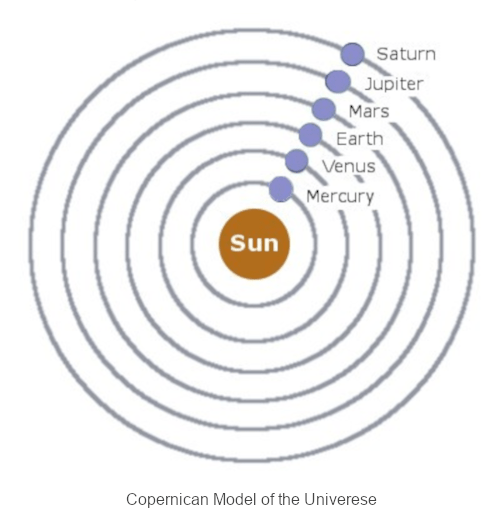
But eventually, the truth prevailed. Perhaps it always does. Eventually the scientific evidence became too obvious In the year 1608 telescopes were invented, which gave astronomers a much more vivid view of the universe. Copernicus didn’t, but Galileo had the use of a telescope. So religion was forced to accept the truth of the Copernican model of the universe. Eventually the ban on the writings of both Copernicus and Galileo was lifted, but not until the early 1800s, by which time Christianity had spread to both North and South America. And as the Copernican view became more widely accepted, some minds began questioning God’s place in it. There is no specific place for God in the Copernican model. Some new beliefs about God developed during that time. Some new ideas developed in America and in Europe. Transcendentalism was a natural philosophy developed by some of the most brilliant literary minds in American history. New Thought Christianity developed as a branch of traditional Christianity during that time. However, most people simply held on to their deep-seated religious beliefs. Most people and religious institutions simply pushed God further out, again. Further out in space. Out there somewhere.
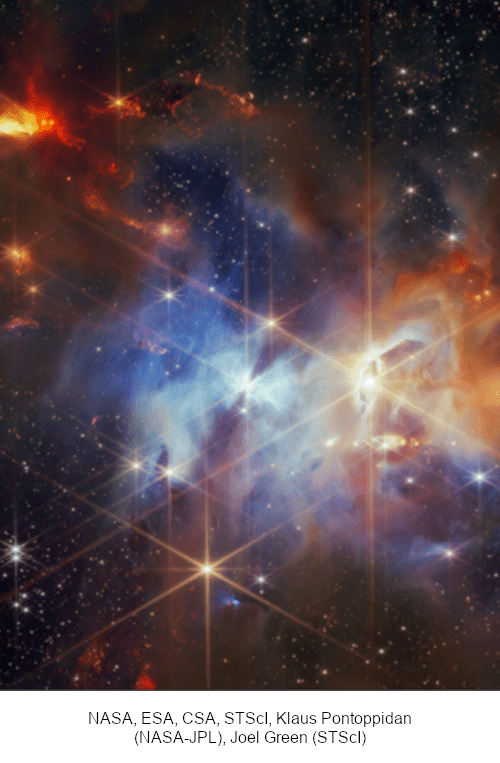
And then came the 1900s. Then came industrialization. Then came the technological revolution. Then came great changes. Then came computers, space travel, and the Hubble Telescope (and now the James Webb Telescope). Things have changed dramatically. The world has changed rapidly. So now in a short period of time, human minds have gone from believing that God is up above the sky, or on the outer edge of the universe, to peering at galaxies light-years away. We now know the universe is vast. We now know the earth is just one planet among trillions. We now know our sun is just one star among trillions. We know the sky is an illusion and God isn’t above it or beyond it. God isn’t up there and God doesn’t seem to be anywhere else out in the physical universe either, at least not in the traditional sense. Not like a king on a throne. Not like a father looking down. So we seem to be in a quandary, we humans. We now know the ancient biblical view of God isn’t real, but we haven’t replaced it with a more realistic one. We recognize the error but we haven’t fixed it. So let’s work on that. Let’s look at another place where God could be. Let’s look at another possibility. And for now, let’s be logical. Logic has its limitation where God is concerned, but hopefully it can give us some direction. Hopefully it can point us in the right direction. Hopefully it can point us to reality. Hopefully it can point us to where God is, realistically.
Footnotes
[1] The Bible, 1 Chronicles 16:30, NRSV.
[2] The Bible, Joshua 10:12-15.
 PD Shoemaker