Chapter 1
Ancient Beliefs
“There have been many theories about the origin of religion. Yet it seems that creating gods is something human beings have always done. When one religious idea ceases to work for them, it is simply replaced. These ideas disappear quietly, like the Sky God, with no great fanfare.”
Karen Armstrong, A History of God
Long ago ancient minds looked out at the world and tried to make sense of what they saw. They saw the land and the sea, the sun, moon, and stars in the sky, and they wondered what these were and where they came from. They looked for explanations and they came to conclusions. They formed beliefs, although primitive ones. They formed beliefs about the world around them and the celestial bodies above. They formed beliefs about that which they could see and also that which they could not see. They formed beliefs about the physical world and they also formed beliefs about an unseen world, inhabited by unseen beings, or a single being, who had created the world. This occurred in virtually all ancient civilizations including that of the ancient Hebrews who wrote our Bibles.
But even though cultures formed their own beliefs, they came in contact with other cultures. They influenced each other, although it was often under hostile conditions. The ancient Hebrews came in contact with the Egyptians, the Babylonians, and other civilizations. A portion of the Hebrew population was exiled in Babylon for seventy years, so they were surrounded by Babylonian culture during that time. This was the Babylonian Exile which occurred from 597 to 538 BCE (BC). The event is recorded in our Bibles and also in some non-biblical writings, such as those of the historian, Josephus. And evidence suggests that Babylonian beliefs influenced ancient Hebrew writings during that time, particularly the creation story found in the first chapter of the Bible. According to current Bible scholarship, such as the JEDP Source Theory, the account of creation found in the first chapter was likely written just after or possibly during the Babylonian Exile.
The Bible is apparently not arranged in chronological order, oldest writings to newest, so in the first chapter of the Bible we actually see a more developed concept of God than in following chapters and books. Chapter 1 depicts a monotheistic God who reigns over all the earth, rather than Yahweh, a god among many gods. The ancient Hebrew concept of God evolved over time, as did their concept of creation, so in the first chapter of the Bible we see a more developed view of the cosmos also— the earth and the heavenly bodies above, although it’s a primitive view in our eyes today. And this view of God and God’s creation has similarities to that of the ancient Babylonians. Archeological discoveries such as the previous map reveal similarities in the beliefs of the two cultures.
The Babylonian Map of the World was discovered on the banks of the Euphrates River in present-day Iraq in the 1800s. The center of the map shows actual geographic locations, such as cities and rivers. The circular area surrounding the center represents water, but rather than the sea, the water apparently represents a mythical ocean surrounding the earth. The triangles extending outward from the water represent regions beyond the sky that were believed to be inhabited by divine beings, according to the inscriptions on the map. The Babylonians believed that the gods had formed the earth when they mixed their waters together, as stated in the opening lines of the Babylonian Epic of Creation, an ancient mythology engraved on stone tablets that were recovered from the ruins of an ancient library also in Iraq. Scholars believe the tablets were created between 1200 BCE and 700 BCE, although the mythology itself is believed to be older. The original title of the epic is Enuma Elis, meaning— when on high in the Akkadian language. The gods were believed to dwell beyond the water surrounding the earth. On high.
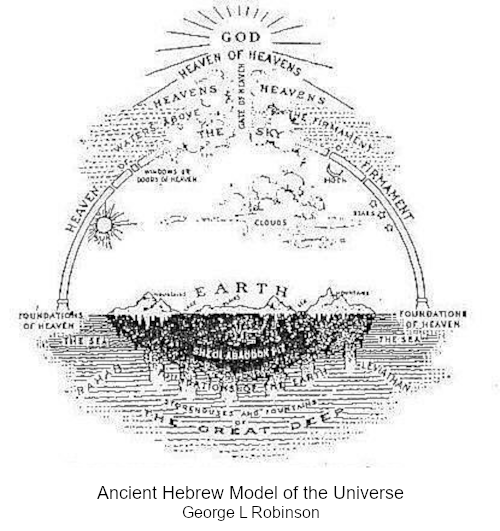
And there are similarities between this view of the cosmos and that found in the Bible. In the first chapter of the Bible, the first creation story, we see that the ancient Hebrews also believed that the world was surrounded by water. The Bible speaks of the water above the earth and the water below the earth. The ancient Hebrews believed the world had been created when the spirit of God moved over the water, as stated in the opening lines of the first chapter. God was believed to be up above the water. But the ancient Hebrews also had some unique variations of the creation story. They believed the water above the earth was held back by a dome, or vault, or the firmament, as it was also called. This was their understanding of the sky. The ancient Hebrews believed the sun, moon, and stars were lights that were attached to the dome, attached to the sky, and they believed God dwelled up above the dome, above the water, above the sky, as recorded in other books of the Bible. The ancient Hebrews had some differences from the Babylonians, but there was a basic structural similarity. And they agreed on this— the divine dwelling was up above. On high.
 PD Shoemaker