Chapter 4
Logical Solutions
“The world as we have created it is a process of our thinking. It cannot be changed without changing our thinking.”
Albert Einstein
And here we shift from focusing on the past to focusing on the present. And the future. Here we shift from focusing on how our beliefs were formed, to forming new beliefs. God isn’t up above the sky like ancient scriptures say, and God doesn’t appear to be anywhere else out in the physical realm either, at least not in the traditional sense. We may recognize the presence of something greater. We may behold the wonders of the universe, the marvels of creation, but no specific being we can point to and say— that is God. Yes, it’s true that we haven’t looked everywhere. Maybe God really is farther out, beyond the reach of our telescopes. Or perhaps on some distant planet. Or through a black hole. But there’s no evidence of these. There’s no evidence of these scenarios. However, we do know of one other place where God could be. We do have one other option.
If God is not in the physical realm, then God must be in the non-physical realm. God must be in the mental realm. God must be in the spiritual realm.
There are two realms of existence that we humans know of, the physical and the mental. All things are one or the other, or at least that’s how they appear. Physical things are made of physical matter or energy. Planets, people, and the wind are physical. The physical realm consists of physical things in three-dimensional space, according to classic Newtonian physics. We perceive physical things with the five senses— sight, sound, smell, touch, and taste, although some things are inferred, like gravity. We humans typically live our lives according to this perspective of life. There’s a reality to it. (And there’s also an illusion to it. According to Einstein’s theory of relativity, and also the observations of quantum physics, the physical world is actually quite different than it appears.[1])
But let’s look at life as it appears to us. We can comprehend that view. It’s familiar to us. There are two realms of existence, the physical and the mental, and the mental realm is fundamentally different than the physical realm. Mental things have no physical substance. I can’t lay them on my desk. They’re not made of physical particles or physical energy. Thoughts, emotions, and memories are mental. Cognition, perception, and sensations are mental. They’re not in three-dimensional space in the same way that physical things are. They’re not perceived by the five senses. I don’t hear my thoughts with my ears, I don’t feel my emotions with my hands, or see my memories with my eyes. Mental things are in our mind, although the mental certainly interacts with the physical. There’s a reality to it. If I bump my head on my desk, my brain processes the nerve impulses, but the hurt is in my conscious mind. I feel it. Our brain is physical, but our mind is not. Nerve impulses are physical, but awareness is not. Our brain and our mind are two distinct things. They’re different substances. One is physical and one is non-physical, although they’re interactive.[2]
So, since there are only two realms of existence that we know of, it seems logical that if God isn’t in one of them, then God must be in the other. If God isn’t in the physical realm then God must be in the mental realm. That seems logical. That seems rational. If God isn’t out there, then God must be in here. God must be in our mind, and I don’t mean imaginary.[3]
So what’s in your mind? What’s goin’ on there? For me, there are these thoughts I’m thinking. These words I’m typing. Operating my fingers. Correcting my mistakes. Staring at the computer screen then glancing out the glass doors to the river behind my home. Breakfast suddenly appearing on my desk! Thank you, Sabrina! But I don’t see God here. Not really. Not actually. No, God doesn’t seem to be in my mind and I suspect you can say the same.
However, there are levels of our mind that we’re not aware of. There are deeper levels. There are levels other than our everyday consciousness that we’re so familiar with. The following is an illustration of these deeper levels. You’ve probably seen it before, or an illustration similar to it. In this model, our conscious mind is like the tip of a pyramid, with most mental qualities and activities being beneath the surface of awareness. Hidden from us. Unknown to us. Like this—
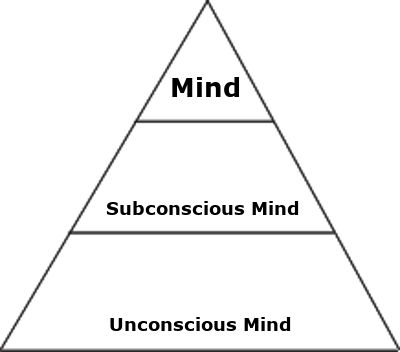
These are the three levels of mind as perceived by psychiatrists in the early 1900s, particularly Sigmund Freud, but the concept of multiple layers of mind is also found in Western philosophy and Eastern religions. The third-century philosopher, Plotinus, perceived that the physical universe emanates from deeper levels of mind, that it was created by those deeper layers. And like Freud in later years, Plotinus also perceived that there are three levels of mind. He called them the Intellect, the Soul, and the One. This model has been influential on this little book. Eastern religions identify numerous conscious and unconscious layers of mind. Eastern religions teach that ultimate being is in a deeper layer.
So, applying some logic to this idea of multiple mental layers, it seems we can come to the following conclusion— If God is in our mind, then God must be in a deeper level. God must be in the deepest level. Something like this—
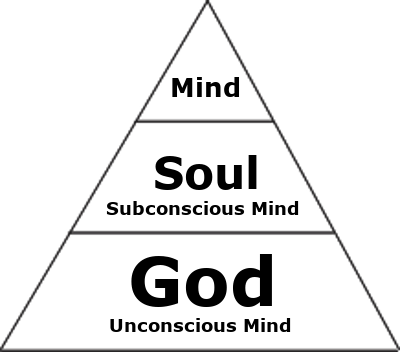
And in this model, the tip of the pyramid is our everyday consciousness, the middle section is our soul, our subconscious, and God is at the base of the pyramid, the essence of all. The Universal Mind would probably be a better subtitle for God in this diagram, rather than the Unconscious Mind, but it’s also true that we humans are typically unconscious of God in that realm. We’re typically not aware of God there, nor are we typically aware of our subconscious mind, our soul.
So, we now come to a possible solution to the problem of where God is. And my logic here isn’t proof, of course. It’s not absolute. But it does what we set out to do. It gives us some direction. It points us in the right direction, I believe. It points us inward. If God isn’t out there, then God must be in here. If God isn’t outside of us, then God must be inside of us. God must be within us. And that may sound familiar to you. You’ve probably heard it before. It’s biblical in some Bibles. “The kingdom of God is within you,” are words attributed to Jesus in early English translations of the Bible, prior to about 1950.[4] “The realm of God is within you,” is an early variation of the same verse.[5] Within our mind, I believe the meaning is. In the subconscious realm or an even deeper level. In a place not visible to human eyes. In a place that is hidden most of the time. And even though this concept of God doesn’t fit too well with some Christian beliefs, it’s scattered throughout Christianity. God is unseen, or in secret, according to the words of Jesus,[6] and there are parables of his that seem to illustrate this same concept, such as the parable of a treasure buried in a field, the parable of a valuable pearl that a merchant found, and the parable of fishermen who cast their nets into the sea and made a great catch.[7] In each of these illustrations, there is something valuable that is hidden and then discovered. Or caught. And it’s the kingdom of God or the kingdom of heaven, in biblical terms. We could call it the domain of God in computer lingo, and it’s apparently not a physical realm. It’s a non-physical realm. It’s a mental realm. It’s a spiritual realm. The word spiritual means non-physical. That’s its definition. And in addition to the previous words of Jesus, it’s also written that he said– “God is spirit.”[8]

Footnotes
[1] Modern physics gives us a much more detailed description of the physical universe. Einstein’s theory of relativity theorizes that all physical matter is actually energy traveling very fast. E=mc2. Quantum physics has concluded that physical matter is comprised of minute subatomic particles, or energy according to Einstein. So it seems that my desk is actually not the solid structure it appears to be. My desk is really minute particles arranged in certain ways. It’s really energy moving so fast that it seems to be solid. But it’s still right here in my room. It’s still right here in front of me. It’s still reality, to me. It still hurts if I bump my head on it.
[2] Materialistic explanations of the mind theorize that consciousness is the product of neural activity in the brain, but there’s no tangible proof of that and the theory has unanswered questions, such as— How do neural impulses produce consciousness? How do they create thoughts and emotions and the ability to reason and make choices? How do they create a reflective mind?
[3] In my experience, however, the more I learned about modern physics, the less clear the distinction between the mental and the physical became. Curved space, time that speeds up and slows down, and scientific observations that interact with the observer are concepts that challenge our logical minds and point us toward something unseen.
[4] The Bible, Luke 17:21. The New Testament of the Bible was first written in the Greek language. The Greek word entos, which appears in this verse, was translated into English as the word within, up until about 1950, then newer version of the Bible began translating the word as– among, or in the midst of, thus equating the kingdom of God with the person Jesus and giving the verse a very different meaning.
[5] The Wycliffe Bible, 1382 -1395 CE, Luke 17:21.
[6] The Bible, Matthew 6:6.
[7] The Bible, Matthew 13:44-47.
[8] The Bible, John 4:24, most versions.
 PD Shoemaker